
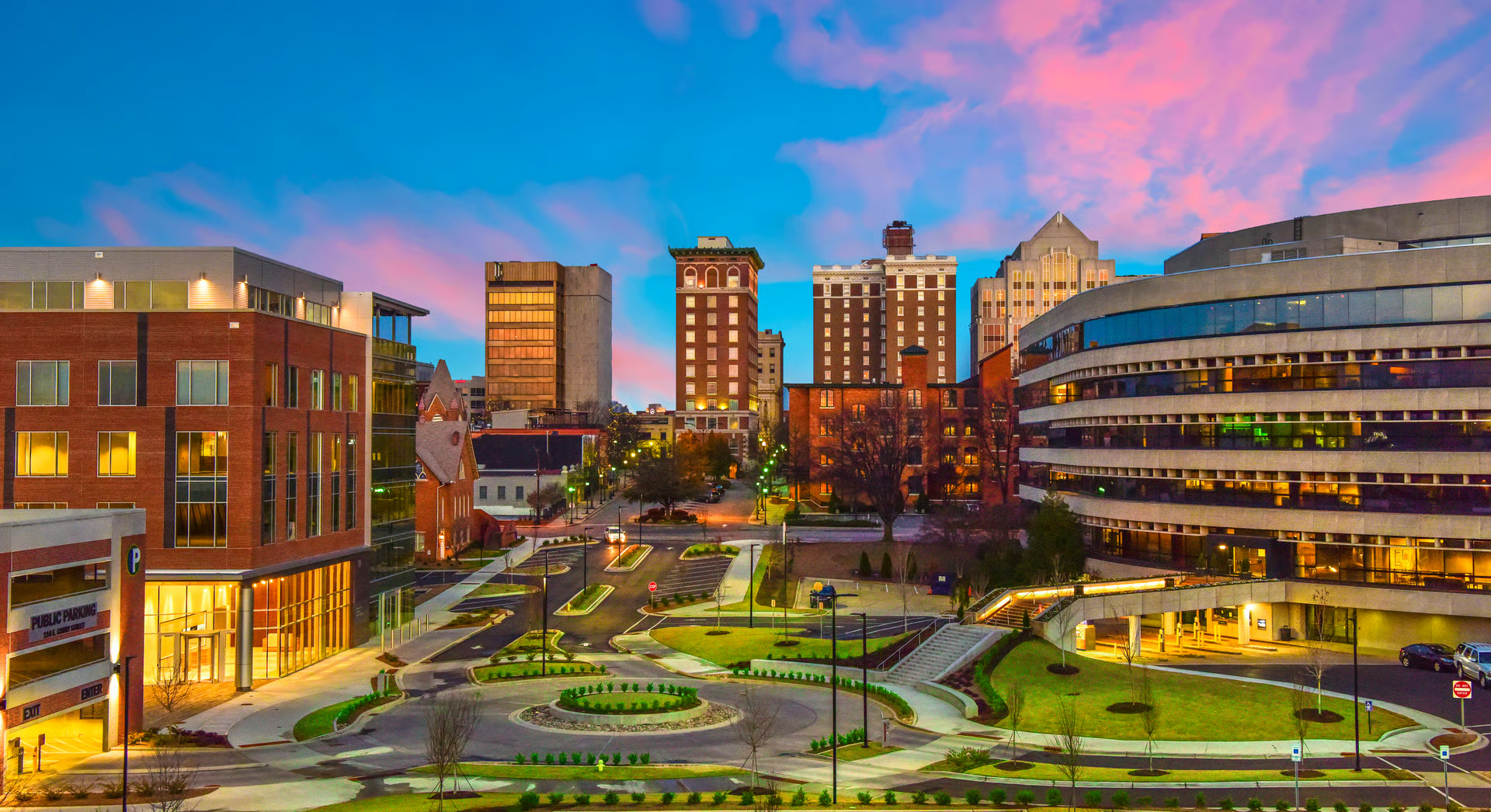
Augusta Street offers an established Greenville corridor known for older homes, neighborhood streets, and convenient access to downtown.
Discover Local CommunitiesIt runs south from Greenville's central business district through several locally recognized residential areas. Here, the area includes renovated historic houses, traditional single-family homes, townhomes, and infill development.
Residents often combine a residential setting with short trips to downtown, the Prisma Health campus, parks, and daily services along Augusta Road.
Conditions can vary by street, development, and jurisdiction, so property-level due diligence remains important.
Cleveland Park, Falls Park, the Swamp Rabbit Trail network, and downtown cultural venues are within the wider Greenville area. School attendance changes block by block and must be confirmed by street address.
School note: Attendance zones, program eligibility, and transportation can change. Confirm every assignment with the district using the full property address before making a housing decision.
Independent restaurants and neighborhood businesses line portions of Augusta Road, while downtown and the West End broaden the dining and shopping mix nearby.
The Augusta Street area runs south from downtown Greenville along Augusta Street and Augusta Road, and it is among the city's most established residential addresses. The range of Augusta Street homes for sale sits beneath a median recorded around $917,000, with single-family figures published between $830,000 and $1,249,000 depending on measure. It is a neighborhood of older houses on mature streets within reach of downtown, and it has been the reference point against which other Greenville neighborhoods are priced.
The headline figure here needs explaining rather than repeating. A regional analysis drawing on Redfin data for the three months ending June 2026 recorded the Augusta Road median down 20.2 percent year over year to about $917,131. Over the same period the number of homes sold rose 41.3 percent and price per square foot fell only 3.5 percent. Those figures together describe a change in what sold rather than a change in what houses are worth: considerably more properties traded and they skewed smaller and cheaper, which pulls a median down without repricing the street.
Pace supports that reading. Homes in the area took 52 days to sell, eight days longer than a year earlier, which is a modest slowing rather than a stall on volume that rose more than 40 percent. For a buyer, the practical consequence is genuinely useful: more inventory is actually closing, at a median that reads lower than the neighborhood's reputation, without the underlying per-foot value having moved much. For a seller, the consequence is the reverse: a median down 20 percent does not mean a house is worth 20 percent less, and pricing off that figure would be a mistake.
The Andy Bovender Team serves the Augusta Street area from Compass offices across the Carolinas, including Greenville, alongside Charlotte, Charleston, Columbia, Fort Mill, Lake Murray, Wilmington, and the Outer Banks. Two things follow. First, on a market where the median moved for compositional reasons, comparables must match on size and era before anything else and the headline figure should not be quoted to a client without the explanation. Second, this is established housing near a growing downtown, so build era, condition, what any renovation did, and whether any preservation designation applies are the questions that decide value.
More Is Actually Selling
Sales volume rose 41.3 percent year over year while price per square foot fell only 3.5 percent. There is more inventory genuinely closing here than a year ago, at underlying values that have barely moved.
A Median That Reads Lower Than the Street
The area's median is down 20.2 percent because smaller and cheaper houses made up more of the mix, not because the neighborhood repriced. For a buyer, that gap between the number and the reality is worth understanding.
Fifty-Two Days, Not a Stall
Homes take 52 days to sell, only eight longer than a year ago. On a neighborhood where volume rose more than 40 percent, that is a market working rather than one seizing up.
Established Houses on Mature Streets
The Augusta Street area is one of Greenville's older residential addresses, with substantial houses and grown trees. It is the reference point other city neighborhoods are measured against.
Walkable to Some of the City's Best Tables
The Vista and The 05 both sit on Augusta Street with 4.6 ratings, and Gather GVL at the downtown end carries more than 3,100 reviews across a multi-vendor site.
Downtown Greenville Just North
Main Street, Falls Park, and the city's employers are a short distance north, covered on the Greenville page, with the West End between, covered in this volume.
The Augusta Street area runs a considerable distance south from downtown, so what varies is how far down the corridor a property sits, its era, and its size. Three groupings and one set of questions cover it.
The Established Housing Along the Corridor
The area's substantial older houses on mature streets are what the Augusta Street name refers to, and they are the top of the market. Because the neighborhood's recent median movement was compositional, a buyer looking at this stock specifically should ignore the headline figure entirely and price from comparables matched on size, era, and condition. Establish what every renovation did and under what permit, the condition of roof, systems, and any original services, and whether any preservation designation applies to the property, since on older housing near a city center that question determines what an owner may change.
The Smaller and Newer Stock
Alongside the larger houses, the area carries smaller and newer property, and it was a shift toward that stock that moved the median. This is the accessible entry into the neighborhood and it is where the additional volume came from. For a buyer, it is also where the arithmetic works: an Augusta Street address at a price well below the area's reputation. Establish the same condition and permit questions, and on any smaller house on a good lot establish whether it is priced as a home or as a redevelopment candidate, because in a close-in neighborhood those are different products at different prices.
The Downtown End
Toward the northern end where Augusta Street meets the city center, property trades on proximity to downtown, the West End, and the restaurants and venues at that end of the corridor. This is the most convenient position and the most exposed to city activity, traffic, and parking pressure. Establish what the city's zoning permits on and around the parcel, because the boundary between an established residential area and a growing commercial core is where use changes, and establish which neighborhood a given address is actually considered part of, since Augusta Street, the West End, and downtown meet here and the labels overlap.
What to Establish Before an Offer
Six questions decide an Augusta Street purchase. Comparables matched on size and era, since the area's median moved for compositional reasons and the headline figure describes a mix rather than a value. The build era and condition of the specific property. What any renovation did and whether it was permitted. Whether the property sits within a preservation overlay or National Register district, which determines what may be changed outside. Whether a smaller house is priced as a home or as land. And which neighborhood the address actually belongs to at the downtown end, where the labels overlap.
The Augusta Street corridor carries restaurants along its length, with a multi-vendor site at the downtown end and independent rooms further south.
The Vista Restaurant and Bar, at 2017A Augusta Street, works whipped goat cheese, tuna tataki, burgers, a grilled chicken sandwich, and seafood features, with attentive service reviewers single out. Closed Sundays, and open from 4 on Mondays.
The 05, at 3016 Augusta Street, is further south, doing tempura vegetables, a dip trio with smoked bacon pimento cheese, garlic romano wings, and a substantial vegan and vegetarian offer including a vegan paella. Dinner only, closed Sundays, and it runs live music.
Gather GVL, at 126 Augusta Street at the downtown end, is a multi-vendor outdoor food hall with hibachi, sushi, barbecue, pizza, burgers, and more across separate operators, with lawn games, live music, and on-site parking. Open seven days.
Beyond the corridor, downtown Greenville and the West End are north with considerably more, both covered on their own pages.
The Augusta Street corridor carries everyday retail and services along its length, which for an established residential area close to a city center means daily life works locally rather than requiring a trip downtown. For a wider run, downtown Greenville is north with Main Street's shops and the city's full range, covered on its own page, and the corridors east and south carry larger-format retail. Buyers should note that Augusta Street is a working corridor carrying commuter traffic into the city as well as local movement, and that how far down it a property sits changes both the errand run and the traffic exposure considerably.
The Augusta Street area's recreation runs on the city's facilities and on proximity to downtown. The City of Greenville and Greenville County both operate parks and recreation programs, and the area's position places Falls Park, the Swamp Rabbit Trail, and downtown's cultural venues within a short distance, all covered on the Greenville page. Within the area itself, the mature streets and established setting are the daily amenity rather than a specific facility.
Beyond the area, the city and the Upstate open in every direction. Downtown Greenville is north with Main Street, Falls Park, and the city's employers, covered on its own page, with the West End between and North Main beyond, both covered in this volume, and Overbrook east. Further out, Simpsonville, Mauldin, and Fountain Inn lie south, Five Forks and Greer east, and Easley and Powdersville west toward Anderson County, all with their own pages. The practical summary is that the Augusta Street area is one of Greenville's most established addresses, and its recent median movement says more about what sold than about what houses are worth.
The Augusta Street area, known to locals as Augusta Road or the 05, is one of Greenville's most established and upscale in-town neighborhoods. It is recognized for its shopping and dining corridor, with boutiques, restaurants, and a Harris Teeter grocery, plus highly rated schools such as Augusta Circle Elementary. Community events include Shagging on Augusta and Lights on Augusta.
Living in the Augusta Street area means walkable access to shops and restaurants along Augusta Road, with quiet residential streets on either side. The neighborhood draws families and professionals, with high household incomes and strong owner-occupancy. Cleveland Park, the Swamp Rabbit Trail, and Prisma Health Greenville Memorial Hospital are all close, and downtown is about two miles north.
Homes in the Augusta Street area carry a median sale price around $830,000, with recent listings closer to $860,000 and prices near $389 per square foot, making it one of Greenville's higher-priced in-town markets. Values range widely, from smaller bungalows to large new-construction and estate homes.
The area offers a mix of historic brick bungalows, ranch homes, and larger traditional houses, most more than 50 years old and frequently renovated. New custom construction appears throughout, including five- and six-bedroom homes. Sub-areas such as Alta Vista, Cherokee Park, and Augusta Circle add gated and architect-designed options.
The Augusta Street area sits just south of downtown Greenville, South Carolina, along the Augusta Road corridor in the 29605 ZIP code. It borders Cleveland Park and the Swamp Rabbit Trail, with Prisma Health Greenville Memorial Hospital, Interstate 85, and downtown all within a short drive.

The Andy Bovender Team pairs deep Carolinas market knowledge with the reach of Compass. Expect straight answers, sharp preparation, and a process that stays simple, whether you are buying, selling, or both.


